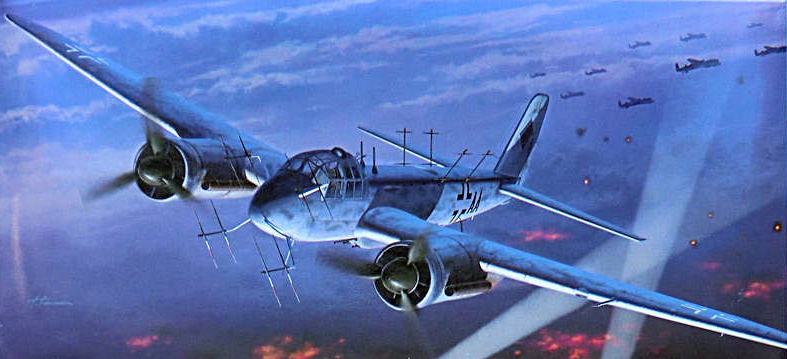
Junkers' final major production night-fighter variant of the Ju 88. It reached front-line units in mid-1944, carrying the full radar and cannon fit available to the Nachtjagd at that stage of the war — but arrived too late to change the outcome of the night campaign.
Pilot
Ofw. Schmidt
Radio operator
Ofw. Michels
Radar operator
Fw. Kretschmer
Air gunner
Uffz. Heidsiek
This crew, flying a Ju 88 G-6, is credited with shooting down RAF Halifax MZ-467 in the early hours of 17 April 1945.
Airframe
G-6 specification
Entered production mid-1944. Compared to the earlier G-1, the G-6 was faster and carried a heavier, more complete sensor fit — the tradeoffs of the late-war Nachtjagd, where equipment kept improving as the strategic situation kept worsening.
Type
Role
Night fighter
In production
From mid-1944
Top speed
360 mph
vs. G-1
+25 mph
Entered combat
Late 1944
Armament
Fit
4× 20mm cannon
Mounting
Ventral pod
Radar fit (typical)
Types carried
FuG 220, 218, 350
Possibly also
FuG 240
Note
Full 1944–45 suite
Radar
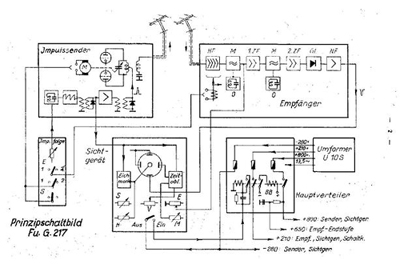
FuG 217 Neptun
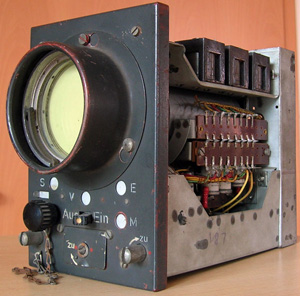
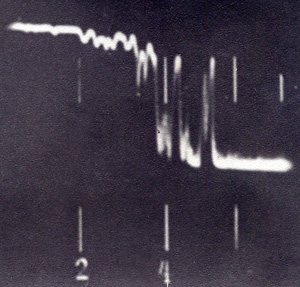
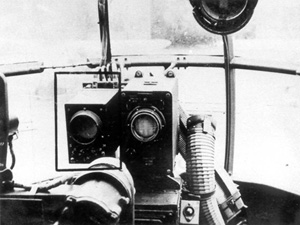
Exact fit unconfirmed for Schmidt's aircraft. Two configurations are plausible for a Ju 88 G-6 in this period: FuG 217 alone, in the combined Ausf. V/R version that handled both forward interception and rearward warning in one unit — or the more commonly documented late-war pairing of FuG 220 Lichtenstein SN-2 for the forward intercept with FuG 217 (R2, rearward-only version) as tail warning. Neptun was installed mainly in the Ju 88 G-6, with only small numbers going to the Bf 110 G-4, He 219, and Me 262. It could be paired with the additional Elfe unit to automatically measure target range and trigger the guns at a pre-set distance.
Unit
Manufacturer
FFO
Frequencies
158 / 187 MHz
Search angle
120°
Range
400–4,000 m
Antenna
Spike / "antler"
Variants
R2
Backward warning
J2
Single-engine fighters
Ausf. V/R
Combined, twin-engine
FuG 217 with case opened, showing internal components.Photo: www.funkstunde.com, used with permissionFuG 217 with screen goals.Photo: www.funkstunde.com, used with permissionFuG 217 installed in aircraft cockpit.Photo: www.funkstunde.com, used with permissionOfficial technical reference.Author: Oberkommando der Luftwaffe, Generalnachrichtenführer, Ln.-Inspektion 6 Abtlg. (1D), Gosewitch
Powerplant
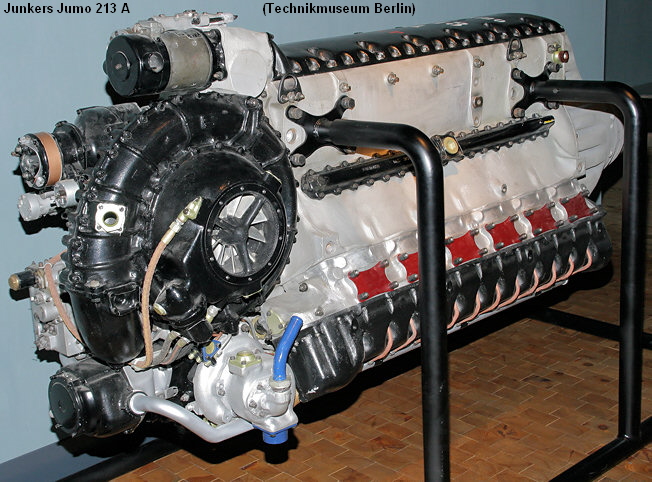
Jumo 213A
A supercharged inverted-V12 developed from the earlier Jumo 211, with a pressurized cooling system that let Junkers shrink the engine and push it to higher RPM. It entered quantity production in 1943–44, later than hoped, and rarely exceeded 400–500 units a month once Allied bombing began targeting the production lines.
General
Layout
Inverted V12
Cylinders
12
Bore × stroke
150 × 165 mm
Displacement
35 L
Dry weight
940 kg
Power
Sea level
865 hp
At 3,000 m
960 hp
Takeoff
1,725 hp
Takeoff (MW50)
2,020 hp
Rated altitude
9,600 m
Systems
Valvetrain
3 valves/cyl.
Supercharger
2-stage, 2-speed
Boost aid
MW50 injection
Cooling
Pressurized, to 120°C
Jumo 213A powerplant.Photo: Wolfgang Bredow
Armament
MG 151/20
The 20mm cannon fitted to Schmidt's aircraft and the type credited with downing MZ-467. Mauser derived it from the earlier 15mm MG 151 by widening the case to take a 20mm shell; the resulting round traded some muzzle velocity for a much larger explosive payload, and became standard armament across much of the late-war Luftwaffe fighter force.
MG 151/20
Caliber
20 × 82 mm
Rate of fire
750 rpm
Muzzle velocity
705–805 m/s
Weight
42.7 kg
Barrel length
1,104 mm
MG 151/15 (predecessor)
Caliber
15 × 96 mm
Rate of fire
740 rpm
Muzzle velocity
850–1,030 m/s
Weight
38.1 kg
Phased out
1942
Effectiveness against heavy bombers. German wartime data put the average hits needed to down a four-engine bomber at roughly 18–25 rounds of 20mm — around 25 for a B-17, slightly fewer for other heavies such as the Lancaster and Halifax — against only about 4 hits to down a single-engine fighter.